Cryptographic Infrastructure for the Data That Defines Your Business
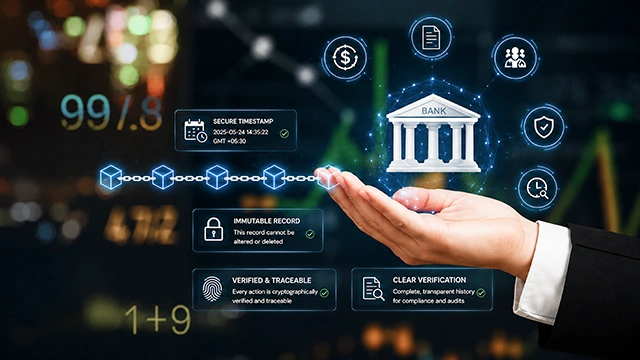
Your most critical records — financial transactions, patient data, supply chain events, legal documents — live in systems that can be quietly edited. ULedger changes that. We anchor your data to an immutable blockchain record with cryptographic proof that it hasn't changed, can't be altered, and will remain verifiable for decades.
We are a Layer 1 blockchain protocol company. Not a consulting firm. We build the infrastructure — post-quantum secure, audit-ready, and compliant out of the box — and we deploy it around your requirements.
We are a Layer 1 blockchain protocol company. Not a consulting firm. We build the infrastructure — post-quantum secure, audit-ready, and compliant out of the box — and we deploy it around your requirements.
Our Collaborative Path
How We Deploy

Schedule a Free Exploration Call
We start with your data problem, not a blockchain pitch. In a 45-minute call our solutions engineers map your compliance requirements, data flows, and verification needs against ULedger's protocol. No demos of features you don't need. Straight answers only.


Strategic MVP Program
Before full deployment, we run a focused proof-of-value pilot with your real data and real workflows. You see Cross-Merkleization, ZK proofs, and BFT finality operating in your environment — before you commit to full rollout. No surprises.


Go Live
Full deployment with SDK integration, infrastructure configuration, and SLA-backed support. Main Network or dedicated enterprise chain — your architecture, your rules, fully cross-mericalized with the broader ULedger ecosystem from day one.




THE CORE PROBLEM
Every Enterprise Data Problem Has the Same Root Cause
The systems storing your most important records can be silently edited. An admin, a vendor, a bad actor — anyone with access can change a record and nobody outside your organization can independently verify it happened. That is a compliance risk, a fraud vector, and a liability that compounds quietly until it becomes a crisis.
ULedger solves it at the protocol level. Every record gets a cryptographic seal. Every change is logged and timestamped. Every audit trail is independently verifiable by any authorized party — without exposing the underlying data. And every signature is protected by post-quantum cryptography that will remain valid long after classical encryption is broken.
ULedger solves it at the protocol level. Every record gets a cryptographic seal. Every change is logged and timestamped. Every audit trail is independently verifiable by any authorized party — without exposing the underlying data. And every signature is protected by post-quantum cryptography that will remain valid long after classical encryption is broken.




DEPLOYMENT OPTIONS
Two Ways to Deploy. One Protocol.
Both options include every ULedger protocol capability — post-quantum cryptography, Cross-Merkleization, ZK proofs, BFT finality, WASM smart contracts. Both interoperate with each other and the full ULedger network.
ULedger Main Network
Shared blockchain. Instant access.
Join the shared ULedger network and start transacting immediately. Infrastructure is fully managed by us. Your data is anchored on-chain — private, tamper-proof, and cross-markellized with every other participant on the network.
Best for:
- Fast, low-friction onboarding
- No dedicated infrastructure required
- Cross-company verification use cases
- Organizations deploying blockchain for the first time
ULedger Main Network
Shared blockchain. Instant access.
Join the shared ULedger network and start transacting immediately. Infrastructure is fully managed by us. Your data is anchored on-chain — private, tamper-proof, and cross-markellized with every other participant on the network.
Best for:
- Fast, low-friction onboarding
- No dedicated infrastructure required
- Cross-company verification use cases
- Full SDK access and custom configuration
Four Core Capabilities. Every Deployment.
Every ULedger deployment — Main Network or dedicated chain — includes these four protocol-level capabilities from day one.

Tamper-Proof Records & Audit Trails
Every record anchored to ULedger gets a cryptographic timestamp and a Groth16 zero-knowledge proof of validity. Once committed, the record is immutable — it cannot be altered without detection. Audit trails are independently verifiable by any authorized party without accessing the underlying data.

Permissioned Enterprise Networks
ULedger's hierarchical wallet system maps your org structure directly onto the protocol. Departments, teams, and individual users each get CRUD-level access permissions enforced at the consensus layer — not the application layer. Revoke an entire division's access in one transaction.

Cross-Merkleization — Trustless Cross-Chain Anchoring
ULedger's patented Cross-Merkleization protocol cryptographically anchors state across independent chains using ZK-SNARK proofs. No bridge contracts. No relay operators. Data integrity is verifiable across organizations, partners, and jurisdictions — without sharing a single byte of the underlying records.

WASM Smart Contracts
WebAssembly smart contracts with gas metering, linear memory isolation, and atomic rollback. Write in Rust, Go, C++, or AssemblyScript. Four native lifecycle stages: Deploy, Invoke, Upgrade, Rollback — no downtime for contract updates.
Real Problems. Protocol-Level Solutions.
Every industry below has a data integrity problem that cannot be solved with traditional databases. Here is exactly what ULedger does about it.
Financial Services & Insurance
The challenge: Real-time settlement finality. Tamper-proof audit trails for FINRA CAT, SEC reporting, and SOX compliance. Insurance claim histories that cannot be disputed. Financial records that must stay confidential for decades — including from quantum computers.
What ULedger delivers: Immediate BFT finality eliminates probabilistic settlement risk — every transaction is final the moment it commits. Groth16 ZK proofs attach a validity certificate to every transaction. ML-DSA-87 post-quantum signatures protect records from harvest-now/decrypt-later attacks. Dedicated chain option provides full data sovereignty for compliance mandates. SOC 2 Type 2 certified out of the box.
What ULedger delivers: Immediate BFT finality eliminates probabilistic settlement risk — every transaction is final the moment it commits. Groth16 ZK proofs attach a validity certificate to every transaction. ML-DSA-87 post-quantum signatures protect records from harvest-now/decrypt-later attacks. Dedicated chain option provides full data sovereignty for compliance mandates. SOC 2 Type 2 certified out of the box.


Healthcare & Life Sciences
The challenge: HIPAA-compliant patient record integrity with granular consent management. Audit trails that survive regulatory scrutiny without exposing protected health information to auditors. Cross-system record verification between providers, payers, and labs.
What ULedger delivers: Hierarchical wallets mirror hospital org structures natively — access controls set at the provider, department, and system level. ZK proofs allow external auditors to verify record integrity without ever accessing the underlying patient data. Immutable audit logs with cryptographic timestamps. HIPAA-ready infrastructure out of the box.
What ULedger delivers: Hierarchical wallets mirror hospital org structures natively — access controls set at the provider, department, and system level. ZK proofs allow external auditors to verify record integrity without ever accessing the underlying patient data. Immutable audit logs with cryptographic timestamps. HIPAA-ready infrastructure out of the box.
Supply Chain & Logistics
The challenge: End-to-end provenance tracking across dozens of partners, warehouses, and carriers. Verified handoffs at every node. Preventing fraud without requiring every counterparty to expose their internal operational data.
What ULedger delivers: Cross-Merkleization lets each supply chain participant anchor their records cryptographically to every other participant's chain — with zero data sharing required. Product origin, shipment events, and delivery confirmations are verifiable across organizations in real time, with no trusted intermediary and no single point of failure.
What ULedger delivers: Cross-Merkleization lets each supply chain participant anchor their records cryptographically to every other participant's chain — with zero data sharing required. Product origin, shipment events, and delivery confirmations are verifiable across organizations in real time, with no trusted intermediary and no single point of failure.


Government & Public Sector
The challenge: Tamper-evident records for contracts, land registries, regulatory filings, and identity management. Auditability that withstands public scrutiny, FOIA requests, and legal challenges. Systems that work across agencies and jurisdictions without shared infrastructure.
What ULedger delivers: Immutable on-chain records with cryptographic timestamps. PLONK block proofs let any authorized auditor verify the complete record history without chain-state access. Permissioned networks keep sensitive data private while maintaining full verifiability of the proof. Cross-Merkleization links records across agencies and jurisdictions with no shared backend required.
What ULedger delivers: Immutable on-chain records with cryptographic timestamps. PLONK block proofs let any authorized auditor verify the complete record history without chain-state access. Permissioned networks keep sensitive data private while maintaining full verifiability of the proof. Cross-Merkleization links records across agencies and jurisdictions with no shared backend required.
Title, Escrow & Legal
The challenge: Document authenticity that is beyond dispute. Property record chains that cannot be quietly altered between closing and recording. Faster closings without more manual verification steps.
What ULedger delivers: Every document hash anchored immutably to the blockchain with a cryptographic timestamp the moment it is created. Cross-Merkleization links records across parties — title company, lender, county recorder — without requiring document sharing. Disputes become provably impossible when the math is the arbiter. Closing processes speed up because authenticity is automatic, not manual.
What ULedger delivers: Every document hash anchored immutably to the blockchain with a cryptographic timestamp the moment it is created. Cross-Merkleization links records across parties — title company, lender, county recorder — without requiring document sharing. Disputes become provably impossible when the math is the arbiter. Closing processes speed up because authenticity is automatic, not manual.


Agentic AI & Autonomous Commerce
The emerging challenge: As AI agents execute payments, sign agreements, and exchange data autonomously, the underlying infrastructure must be trustless, verifiable, and millisecond-fast. Probabilistic finality and volatile gas fees make most blockchain platforms unusable for agentic workflows.
What ULedger delivers: Immediate BFT finality lets AI agents settle micro-transactions with the speed autonomous workflows require. ZK proof coverage on every transaction provides verifiable authenticity at scale. Native token standards — fungible, NFT, and multi-token — support any agentic economic model. ULedger is purpose-built for the infrastructure layer of the emerging agentic economy.
What ULedger delivers: Immediate BFT finality lets AI agents settle micro-transactions with the speed autonomous workflows require. ZK proof coverage on every transaction provides verifiable authenticity at scale. Native token standards — fungible, NFT, and multi-token — support any agentic economic model. ULedger is purpose-built for the infrastructure layer of the emerging agentic economy.
How ULedger Compares
Most enterprise blockchain comparisons focus on features. This one focuses on what actually matters in regulated environments.
FAQ's
Frequently Asked Questions
What exactly does ULedger do?
ULedger is a Layer 1 blockchain protocol that makes enterprise data tamper-proof, independently verifiable, and quantum-resistant. Every record anchored to ULedger gets a cryptographic seal and an immutable audit trail. Authorized parties can verify those records at any time — without seeing the underlying data and without relying on a trusted intermediary.
What is Cross-Merkleization and why does it matter?
Cross-Merkleization is ULedger's patented protocol for cryptographically anchoring state between independent blockchains. When a block finalizes on Chain A, its ZK-proven header gets embedded into every connected chain's next block — creating trustless, permanent, mathematically verified binding between chains. No bridge contracts. No relay operators. No counterparty trust required.
Do I need to hold cryptocurrency or pay gas fees to use ULedger?
No. ULedger runs on flat-rate licensing. Zero gas fees, zero token requirements, zero exposure to crypto market volatility. You get a predictable line item that enterprise finance teams can plan around.
What is post-quantum cryptography and why do I need it now?
Post-quantum cryptography uses algorithms that remain secure even against quantum computers. ULedger ships ML-DSA-87 — the NIST FIPS 204 standard, CRYSTALS-Dilithium Level 5 — natively in the protocol. The reason you need it now: attackers are harvesting your encrypted data today to decrypt it once quantum computing matures. That is called a harvest-now/decrypt-later attack. If your records have long-term sensitivity — financial, legal, healthcare — the window to protect them is before the threat arrives, not after.
What is the difference between the ULedger Main Network and a Dedicated Enterprise Chain?
The Main Network is a shared blockchain managed entirely by ULedger — fastest path to deployment, no infrastructure required. A Dedicated Chain is a sovereign ULedger blockchain configured specifically for your organization, with full SDK access and data sovereignty. Both options include every protocol capability and both cross-merkelize with each other and the broader ULedger network. The choice comes down to your compliance posture, not feature availability.
How does ULedger handle access control for large organizations?
Through a hierarchical wallet system that maps your actual org structure directly onto the protocol. Every department, team, and user gets a wallet with named permission groups and CRUD-level access — enforced at the consensus layer, not the application layer. If you need to revoke access for an entire department or offboard a vendor, one transaction disables the parent wallet and cascades atomically to every descendant. No orphaned active accounts, no manual cleanup.
Can ULedger integrate with our existing ERP, CRM, or data platforms?
Yes. ULedger is built SDK-first. Developer-first SDKs connect the protocol to your existing enterprise stack — ERP, CRM, databases, data platforms — without requiring you to rebuild your infrastructure. The goal is to strengthen your existing systems with cryptographic integrity, not replace them.
Is ULedger SOC 2 and HIPAA compliant?
Yes. ULedger is SOC 2 Type 2 certified and HIPAA compliant. Both badges are displayed in the site footer. For regulated industries — financial services, healthcare, government — these certifications matter before any procurement conversation gets started.
What does the ZK proof system in ULedger actually do?
ULedger uses two complementary zero-knowledge proof systems. Groth16 generates a per-transaction validity certificate (~200 bytes) proving the transaction is valid without revealing any private inputs — the sender's key, the payload, or the wallet state. PLONK generates a per-block header proof (~500 bytes) covering the entire block's Merkle tree integrity. Together, they let any authorized external party verify an entire block's correctness — including every transaction inside it — without downloading chain state or accessing any underlying data.
How long does it take to deploy?
Main Network onboarding can be completed in days. A dedicated enterprise chain deployment timeline depends on your infrastructure requirements, compliance configuration, and SDK integration scope — typically a few weeks for a focused pilot. We scope it precisely during the free exploration call, so you know the timeline before you commit to anything.